
At 3,500 meters of altitude, in Cusco’s Sacred Valley, there is a set of circular agricultural terraces that continues to raise questions among archaeologists and historians since it was first documented: Moray. We look at what we know about the Moray terraces and what they may have been used for.
An Amphitheater With Many Different Climates
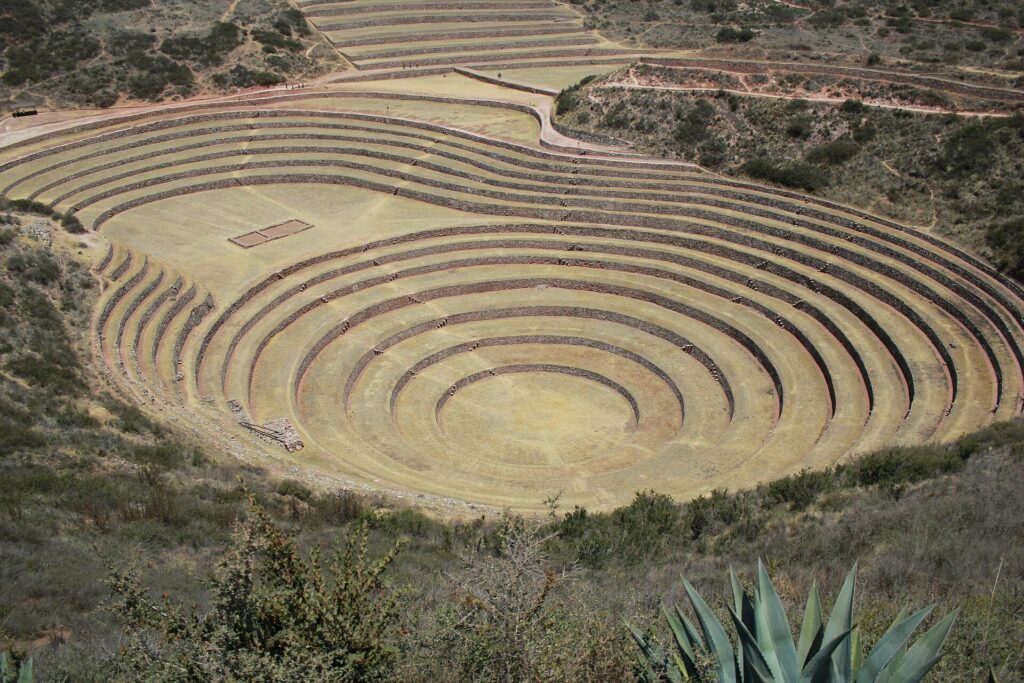
Moray consists of several natural depressions in the terrain, each surrounded by concentric circular terraces descending toward the center. This arrangement generates a notable temperature gradient: according to various measurements, there can be up to 15°C of difference between the top terrace and the deepest point of the complex — enough for each level to effectively represent climate conditions typical of different altitudes within a single compact space.
An Agricultural Laboratory Before the Term Existed
The most widely held theory among researchers is that the Incas used Moray as an agricultural experimentation center — a place to test crops from different regions of the empire under controlled temperature and humidity conditions, before deciding where and how to grow them at larger scale. It’s essentially the same principle behind any modern agricultural experiment station, applied centuries earlier with entirely different tools.
Alternative Theories About Its Use
Not all researchers agree that Moray was used exclusively as an experimental center for food crops. Photographer and explorer Edward Ranney, for instance, has suggested the site may have been dedicated to cultivating some of the Incas’ most prized plants, among them the coca leaf, given its ceremonial and social importance in Inca society. Other interpretations point to mixed use, combining agricultural experimentation with a possible ritual meaning, given how deliberately the space was laid out.
The Hydraulic Engineering That Made It Possible
Beyond the terraces themselves, Moray features a carefully designed drainage system that prevents water from pooling at any level, even during the rainy season — an engineering detail that has allowed the structure to remain functional centuries after its construction, without erosion compromising its integrity.
A Site Still Under Study
Despite decades of archaeological research, Moray continues to raise questions without a definitive answer. Archaeologists and scientists still use the site to study both traditional agricultural techniques and their potential application to current sustainability challenges in mountain agriculture.
At Colibrí Origins, places like Moray are a reminder that the relationship between Andean agriculture and innovation is not a recent phenomenon — the Incas already understood, with the knowledge available in their time, that experimenting with growing conditions was the only way to adapt to the planet’s most demanding geography.