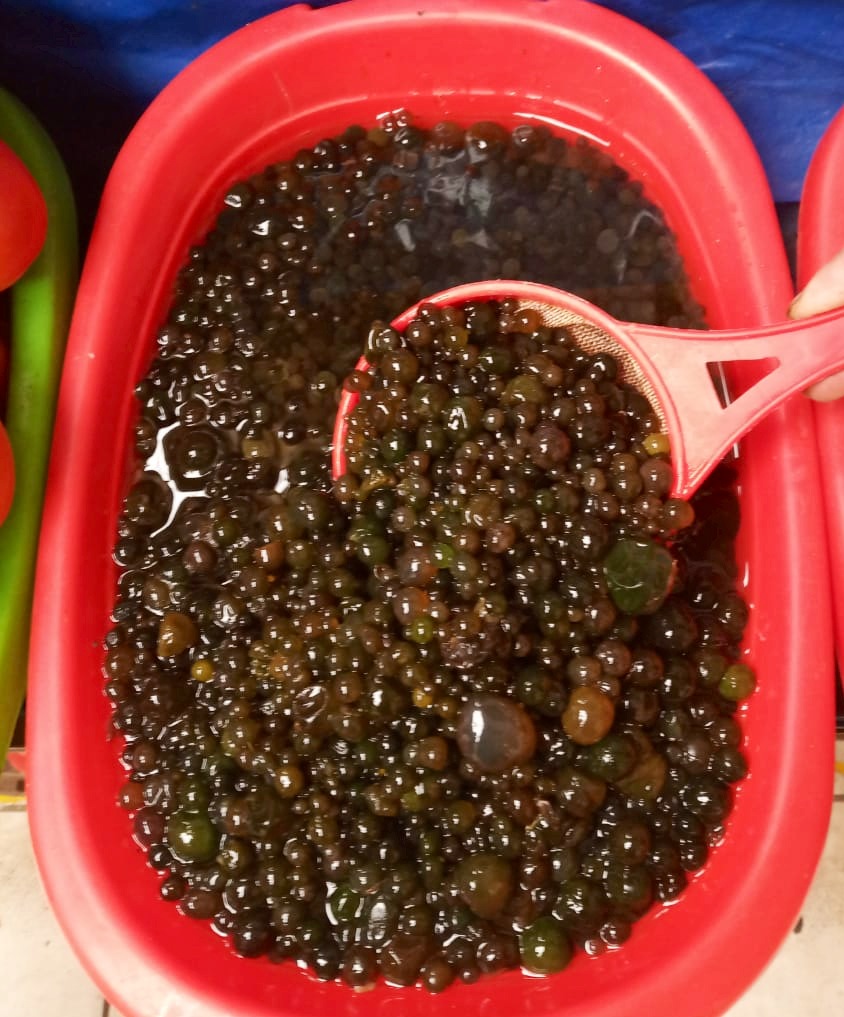
In the crystalline lagoons of the Peruvian Andes, above 3,000 meters of altitude, grows an ancestral food that few outside Peru have ever heard of: the cushuro, Andean alga. This small spherical alga, also known as murmunta, llullucha, or luche depending on the region, has been part of the Andean diet since pre-Inca times — and is, without a doubt, one of the least internationally known ingredients in Peru’s entire catalog of biodiversity.
An Exclusive Inhabitant of High-Altitude Lagoons
Unlike most of the crops that go into our formulas, the cushuro isn’t sown or harvested from the ground — it grows naturally in the crystalline waters of the high-Andean lagoons of Áncash, Junín, Cajamarca, Huánuco, Cusco, and Puno, always above 3,000 meters above sea level. Its scientific name is Nostoc sphaericum, and it belongs to a group of cyanobacteria capable of fixing nitrogen directly from the environment, which favors its growth in pure, nutrient-rich waters.
One Food, Many Names
Depending on the Andean region where it’s gathered, this food goes by different names: cushuro and murmunta in areas of Aymara tradition, and llullucha or luche in areas of Quechua tradition. This variety of names reflects how widespread its consumption has been across the Peruvian Andes for generations, long before a unified scientific name existed to classify it.
Composition
Cushuro is characterized by its high protein content (between 30% and 42% according to various studies) and its contribution of essential amino acids, along with minerals such as calcium, iron, and magnesium — a composition that sets it apart from other traditional Andean foods.
This content is for general informational purposes only and does not constitute medical advice or replace the guidance of a healthcare professional.
A Wild Resource Under Study
Unlike already domesticated crops like maca or quinoa, cushuro is still mainly gathered from its natural habitat, without widely established controlled cultivation methods. This dependence on wild harvesting has raised concerns about overexploitation of the lagoons where it grows, and several Peruvian universities — including Universidad Científica del Sur — have been developing alternative cultivation methods to protect this resource in the long term.
A Look at Its Preparation
Before being consumed, cushuro is carefully cleaned to remove any plant matter or mineral residue from the lagoon, and then incorporated directly into whichever dish is being prepared, without requiring a debittering process like the one needed for other Andean ingredients such as tarwi.
Cushuro in Traditional Andean Cuisine
In the communities near the lagoons where it grows, cushuro has been part of traditional cuisine for generations — it’s prepared in soups like chupe de cushuro, in salads, and as an accompaniment to other Andean dishes. It’s an ingredient that, although practically unknown outside Peru, holds an established place in the gastronomy of the high-Andean areas where it’s gathered.
A Harvest That Follows the Natural Calendar
The gathering of cushuro traditionally follows the natural cycles of the high-Andean lagoons, tied to the rainy season, when the alga proliferates most abundantly. The communities that gather it have, over time, developed their own rules about when and how much to harvest, aiming not to deplete a lagoon’s resource from one season to the next — a form of traditional management that today complements the scientific research into its cultivation.
At Colibrí Origins, we continue exploring the Andean and Amazonian biodiversity of Peru, and cushuro is a good example of how much there still is to discover: a food with centuries of history, several names depending on the region, and a future that depends, in part, on our learning to cultivate it with the same care nature uses to grow it in its high-altitude lagoons.