Unlike the aguaje, which is still waiting to be discovered by the rest of the world, maca needs no introduction: it’s sold in capsules, powder, and gelatinized form in health food stores across half the planet, and is probably the most internationally recognized Peruvian superfood. What’s rarely told is where it actually comes from — and what it takes to get there.
Life above 3,800 meters
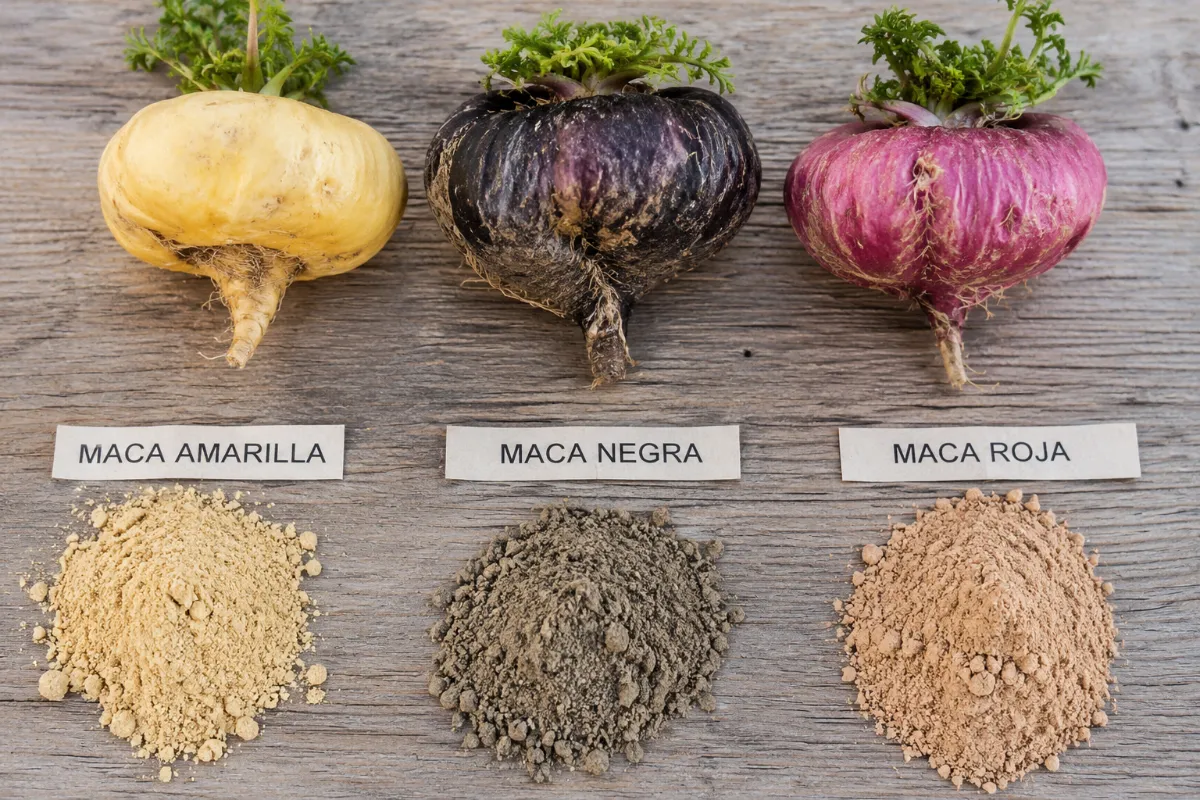
Lepidium meyenii, maca’s scientific name, is grown in the high sierra of the Peruvian Andes, between 3,800 and 4,500 meters above sea level, mainly in the regions of Junín, Pasco, and Puno. It is one of the few crops capable of thriving at that altitude, and its hypocotyl — the part of the root that is harvested and consumed — depends directly on seasonal rainfall to develop. Although the hypocotyl can take on different shades, the most recognized varieties of the crop are grouped by color: yellow or cream, black, and red, like the one shown in the photograph.
From the root to the formats you already know
That dependence on rainfall contrasts with how familiar the final product is: gelatinized, in capsules, or as a powder, maca is today the most internationally recognized Peruvian superfood. But between the freshly harvested root in the sierra and the jar that reaches other markets lies a distance — of altitude, climate, and labor — that is rarely mentioned.
This content is for general informational purposes only and does not constitute medical advice or replace the guidance of a healthcare professional.
A reputation that doesn’t always match the harvest
Maca’s international recognition doesn’t always match the reality on the ground. The sector has come through several seasons of lower-than-expected yields in Junín and Pasco, and producers remain cautious amid price volatility. It’s a tension rarely visible from the outside: global demand keeps growing, while production still depends on altitude, climate, and land that doesn’t always cooperate.
From Inca Tribute to Global Product
Long before becoming an internationally recognized export product, maca was already valued in the Andes: there are records of its use as part of the tribute paid during the Inca Empire, and its cultivation in the Junín area dates back several centuries. The leap to the international recognition it enjoys today is, historically speaking, relatively recent — most of its history as a crop has unfolded locally, within the Peruvian Andes.
Traditional Ways of Preparing It in the Andes
In the Andean communities where it is grown, maca is traditionally consumed in ways quite different from those known outside Peru today (capsules, powder, gelatinized form). Among the best-known traditional preparations are mazamorra de maca, a type of cooked dessert or cream, and chicha de maca, a locally consumed fermented beverage. These preparations remain in use in the Peruvian highlands today, alongside the more industrialized formats that reach other markets.
Maca is already known around the world. What few still know is the demanding origin behind it — and it’s that part of the story, the story of the high sierra and its producers, that we at Colibrí Origins want to keep telling.
Three Colors, One Crop
As mentioned in this post’s photograph, Peruvian maca isn’t a uniform crop — there are recognized varieties grouped mainly by the color of their hypocotyl: yellow or cream (the most common and commercially available), black, and red. Although all three come from the same species (Lepidium meyenii), local producers and consumers usually distinguish them by their growing characteristics and traditional uses in Andean cuisine.
A Crop That Depends on Very Specific Conditions
Few plants in the world can develop commercially above 4,000 meters of altitude, in soils with considerably lower oxygen levels than at sea level and exposed to frequent nighttime frosts. Peruvian maca is one of the exceptions — but that same specialization makes it vulnerable to any significant climate disruption, such as the rainfall variability reported in recent years in the high-Andean regions where it is grown.
From Local Crop to Export Product
The journey maca takes from a plot in Junín, Pasco, or Puno to a jar in an international market involves multiple stages: harvest, drying (traditionally in the sun, a process that can take weeks), selection, and processing according to the final format (powder, capsules, or gelatinized form). Each of these stages represents both an opportunity to add value and a point where traceability can be lost if not carefully documented — something we consider essential to maintain for any ingredient that becomes part of our formulas.