Peru is not the largest cocoa producer on the planet, but it is one of those that gets noticed most. Its chocolate bars reach the podium in international competitions, and most of the beans it exports are fine or flavour cocoa, the kind craft chocolate makers look for. Here is a tour, with a map, of what makes Peruvian cacao well known.
A cacao recognised around the world
The International Cocoa Organization (ICCO) classes as “fine or flavour” the cocoa that is valued for its taste and not only for its quantity. In an April 2024 decision, the ICCO put the share of Peru’s cocoa bean exports that falls into that category at 75%.
Competitions point the same way. At the fourth AVPA cocoa and chocolate awards, held at the Salon du Chocolat in Paris in 2024, Peru won 40 of the 93 medals, according to the Peruvian Chamber of Coffee and Cocoa. The medallists came from Huánuco, Junín, Ayacucho, Cusco, San Martín and Puno.
In November 2025, a Cacaosuyo bar, “El Ganso”, made with cacao from Junín, received the top prize (“Overall Winner”) at the 2025 International Chocolate Awards, with 91.6 points.
Where Peruvian cacao grows
Three jungle regions produce almost three out of every four tonnes. Tap a number on the map to see the story of each place.
In 2020, when Peru produced 160,289 tonnes, San Martín contributed 43%, Junín 17%, Ucayali 14%, Huánuco 9% and Cusco 5%. The five regions together made up about 87% of national production.
Peruvian cacao varieties at a glance
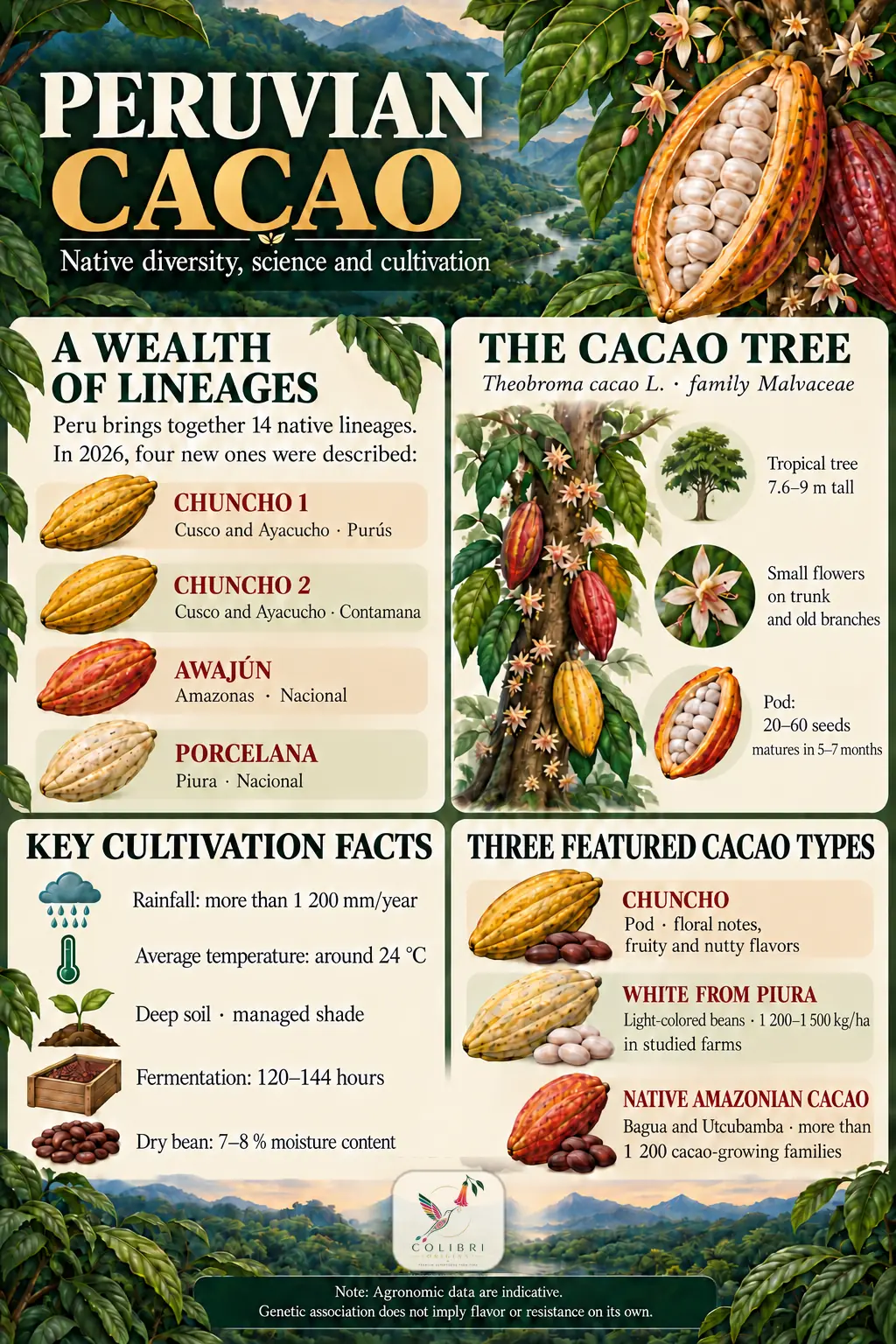
Peru does not have a single cacao variety, but several genetic lineages of its own. In July 2026, a study published in PLOS ONE described four new ones (Chuncho 1, Chuncho 2, Awajún and Porcelana), bringing Peru to 14 native lineages, according to Mongabay.
Chuncho, from La Convención (Cusco), is described with floral, fruity and nutty notes. Blanco de Piura gave between 1,200 and 1,500 kg of dry beans per hectare on the farms studied. The native cacao of Amazonas, from Bagua and Utcubamba, has a denomination of origin. That a lineage descends from a group associated with fine cacao is a clue, not proof of flavour.
An industry that has grown very fast
The area planted with cacao grew from no more than 10,000 hectares in 2000 to more than 230,000 hectares today, according to the consultant José Yturrios. Between January and October 2024, exports of cocoa and derivatives passed 1 billion dollars: more than 600 million in beans and about 400 million in value-added products, such as butter, powder, liquor, paste and chocolate.
According to the Ministry of Agrarian Development and Irrigation (Midagri), Peru is the world’s eighth-largest exporter of cocoa beans, and nearly 90,000 small family farmers grow it across 16 regions. That matters: behind Peruvian cacao there are mostly small farms.
Cacao Amazonas Perú: a denomination of origin
In 2016, Indecopi granted the denomination of origin “Cacao Amazonas Perú”, the tenth in Peru. It protects native, dry-fermented cacao grown in the provinces of Bagua and Utcubamba, in the Amazonas region, between 450 and 1,200 metres above sea level. It is described as having dried-fruit aromas, such as almond and hazelnut.
In 2022, the denomination benefited more than 1,200 cacao-growing families. A denomination of origin means the name can only be used for cacao that comes from that area and meets set rules.
Is Peru the cradle of cacao?
It is worth being precise here. The oldest known use of cacao has been found in the Ecuadorian Amazon, about 5,300 years ago, according to a 2018 study published in Nature Ecology & Evolution. The upper Amazon, which Peru shares with its neighbours, is the region the tree comes from.
Peru does not need to be the cradle to have a place of its own: it has local varieties, fast-growing production and a recognition that is being earned today at the table and in competitions.
What we learn from cacao
Peruvian cacao shows something that holds for all of the country’s biodiversity: value does not lie only in the raw material, but in the origin, in the care of those who grow it, and in the transformation. At Colibrí Origins we believe this is the way forward for products that come from the Andes and the Amazon.
Regional production figures are from 2020 and may have changed. Awards are the results of specific competitions, and the 2024 export figures are provisional. The data come from the sources cited and may vary by organisation and year.
Sources
- ICCO: Revision of Annex “C” of the International Cocoa Agreement, 2010 (April 2024). https://www.icco.org/revision-of-annex-c-of-the-international-cocoa-agreement-ica-2010-3/
- Peruvian Chamber of Coffee and Cocoa: Peru at the 2024 AVPA awards. https://camcafeperu.com.pe/EN/article.php?id=223
- Infomercado: Peru wins world gold at the International Chocolate Awards 2025 with Cacaosuyo. https://infomercado.pe/peru-gana-el-oro-mundial-en-los-international-chocolate-awards-2025-con-cacaosuyo/
- Agraria.pe: San Martín, Junín and Ucayali generate 74% of national cacao production (2021, 2020 data). https://agraria.pe/noticias/san-martin-junin-y-ucayali-generan-el-74-la-produccion-nacio-25580
- Agraria.pe: Peruvian exports of cacao and derivatives passed US$ 1 billion (November 2024). https://agraria.pe/noticias/exportaciones-peruanas-de-cacao-y-derivados-superaron-los-us-37614
- Andina: Peru is the world’s eighth-largest exporter of cacao beans. https://andina.pe/ingles/noticia-peru-is-worlds-eighthlargest-exporter-of-cacao-beans-1036367.aspx
- Agraria.pe: Indecopi granted a denomination of origin to Cacao Amazonas Perú (2016). https://agraria.pe/noticias/indecopi-otorgo-denominacion-de-origen-a-11950
- Andina: World Cocoa Day, the denomination of origin benefits 1,200 families in Amazonas (2022). https://andina.pe/agencia/noticia-dia-mundial-del-cacao-denominacion-origen-beneficia-a-1200-familias-amazonas-900468.aspx
- Zarrillo et al.: The use and domestication of Theobroma cacao during the mid-Holocene in the Upper Amazon (Nature Ecology & Evolution, 2018). https://digitalcommons.kennesaw.edu/facpubs/4424
- Motilal et al. (2026). Genetic structure of traditional cacao reveals four new genetic lineages in indigenous Amazonian sites in Peru. PLOS ONE. https://doi.org/10.1371/journal.pone.0351690
- Mongabay: Native cacao in Peru, a study reveals new lineages (July 2026). https://es.mongabay.com/2026/07/cacao-nativo-peru-estudio-revela-nuevos-linajes-refuerza-origen-amazonico/
- Alliance Bioversity-CIAT: Native fine-flavor cacao can match commercial varieties in yield (2026). https://alliancebioversityciat.org/stories/native-fine-flavor-cacao-commercial-varieties-yield
- Céspedes-Del Pozo, Blas-Sevillano and Zhang (2017): Chuncho native cacao in La Convención, Cusco. https://www.icco.org/wp-content/uploads/T1.84.-ASSESING-GENETIC-DIVERSITY-OF-CACAO-Theobroma-cacao-L.-NATIVO-CHUNCHO-IN-LA-CONVENCION-CUSCO-PERU.pdf
- INIA (2009): Cacao cultivation. https://repositorio.inia.gob.pe/bitstream/20.500.12955/177/1/Cultivo_cacao_2009.pdf
- University of Florida (IFAS): Cacao, Theobroma cacao. https://ask.ifas.ufl.edu/publication/HS307