
Peru’s coast is one of the driest on the planet. And yet, just offshore, lies one of the richest seas for fish in the world. It is not a paradox: both have the same cause. A current of cold water flowing up from the south explains both the coastal desert and the abundance of life in the ocean.
A country among the giants of fishing
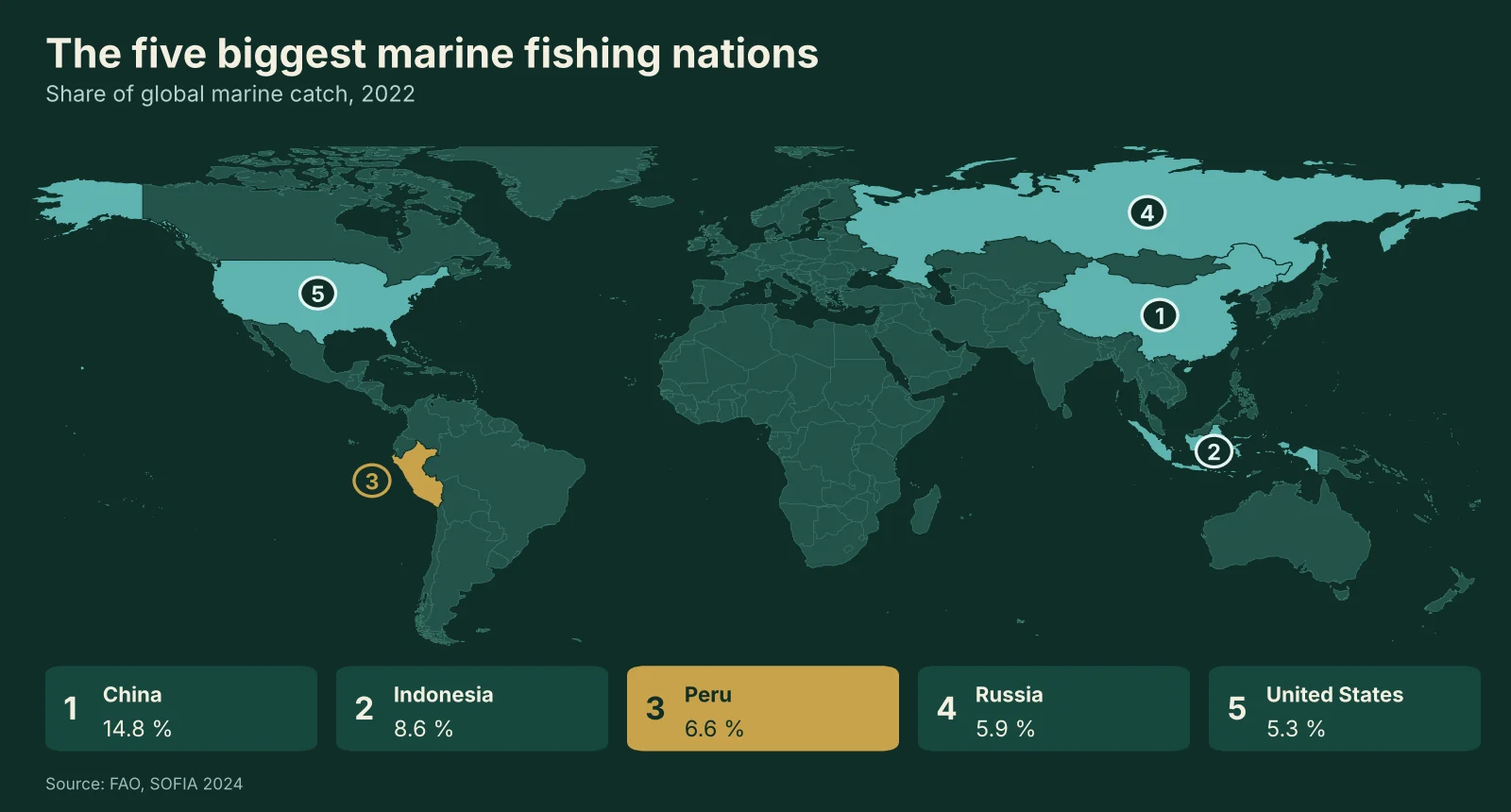
According to FAO, in 2024 Peru caught 5.7 million tonnes, the largest capture fisheries production in Latin America and fourth in the world. Two years earlier, in 2022, it accounted for almost 6% of global capture and was the only Latin American country in the top ten.
Looking only at marine fishing in 2022, Peru was the third country in the world, with 6.6% of the global catch. Only China (14.8%) and Indonesia (8.6%) were ahead, and Russia (5.9%) and the United States (5.3%) came behind.
How does a country with a desert coast achieve this? The answer begins below the surface.
The Humboldt Current, the invisible engine
The Humboldt Current, also called the Peru Current, is a cold-water current about 900 kilometres wide that flows north along the west coast of South America, from Chile to Ecuador. It is named after Alexander von Humboldt, who in 1802 measured how cold the water was compared with the air.
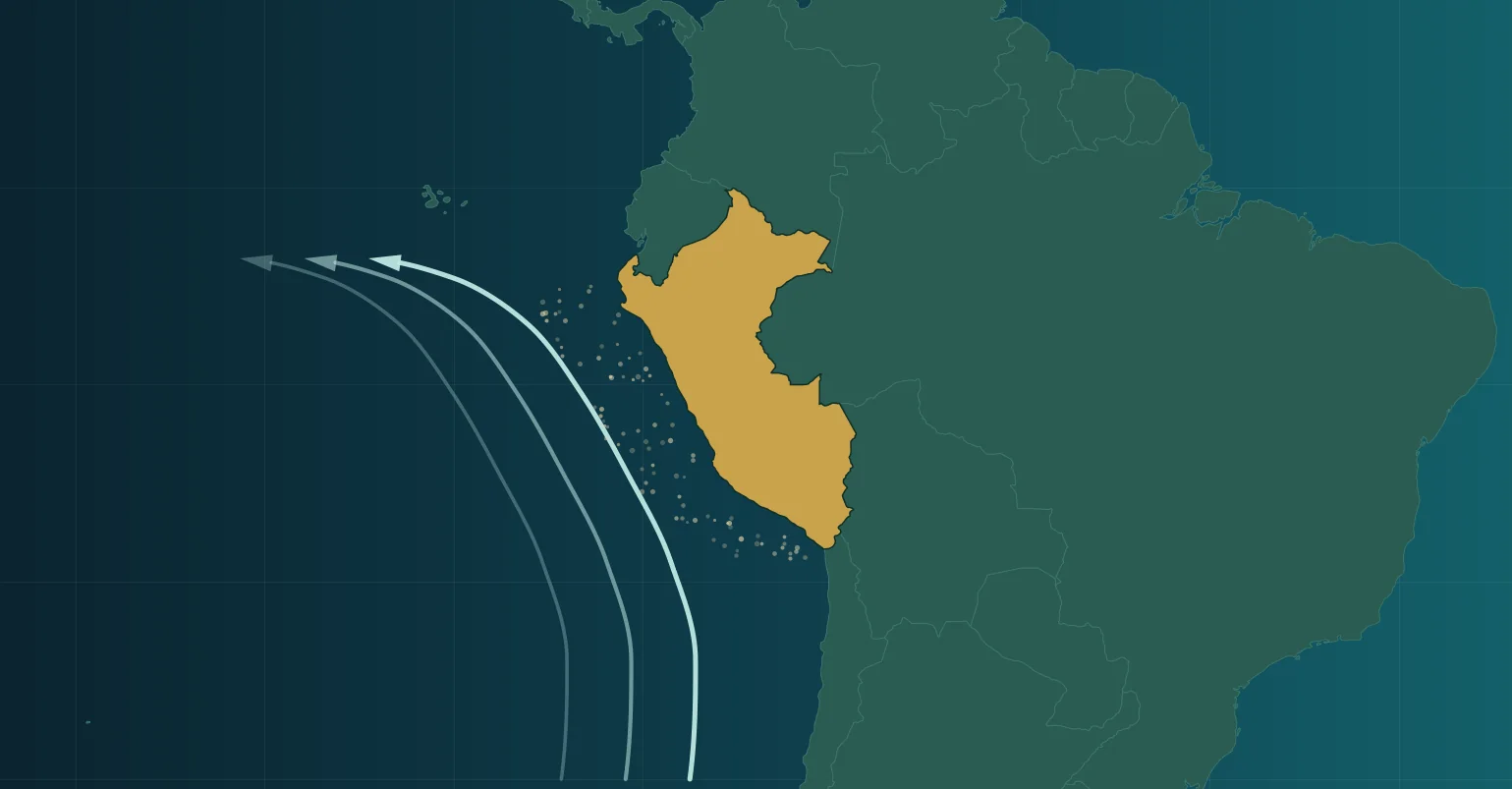
The southeast trade winds and the Earth’s rotation push surface water away and draw up deep water loaded with nutrients. This is upwelling. The nutrients feed phytoplankton, the microscopic organisms at the base of the food chain. Zooplankton feeds on them, small fish feed on zooplankton, and then the predators arrive.
The same cold water brings fog to the coast and helps make it one of the driest regions in the world. That is why such a rich sea washes such a dry shore.
The anchoveta: a small fish that moves a global market
If one species sums up this sea, it is the anchoveta, or Peruvian anchovy (Engraulis ringens), a small fish that forms huge schools. In 2022 it made up around 77% of Peru’s marine catch, according to the OECD, and it was the most heavily caught marine species on the planet, at almost 4.9 million tonnes, according to FAO.
Almost all Peruvian and Chilean anchoveta is turned into fishmeal and fish oil, used mainly to feed animals and aquaculture. It is not the fish that goes straight to the plate.
El Niño: when abundance is not guaranteed
Abundance does not mean security. In 2023, with El Niño and many juvenile fish in the sea, Peru cancelled its main anchoveta fishing season. Global fishmeal supply fell by 23% that year, according to IFFO.
Recovery came in 2024. FAO describes a strong rebound, with anchoveta catches almost 65% higher, and global fishmeal supply rose by 26%. A single fish, in a single country, can move the world market for animal feed.
Beyond the anchoveta
Peru’s marine wealth is not only anchoveta. Other species play an important role in fishing and in gastronomy:
- Jumbo flying squid, or pota (Dosidicus gigas): 621,852 tonnes were landed in 2023, 36% more than the year before, according to Undercurrent News. Its sales exceeded 800 million dollars.
- Jack mackerel, or jurel (Trachurus murphyi) and chub mackerel, or caballa (Scomber japonicus): pelagic fish, like the anchoveta, that depend on ocean conditions.
- Hake, or merluza (Merluccius gayi peruanus): a demersal species that lives close to the seabed, so it is managed differently from pelagic fish.
Each species has a different place in the ecosystem and in the fishing economy.
A natural wealth that demands knowledge
The value of a natural resource is not measured in tonnes alone. It depends on fish populations staying healthy, on understanding the cycles of the ocean and on managing it with science, as what happened between 2023 and 2024 shows.
At Colibrí Origins, we believe that knowing Peruvian biodiversity means looking beyond the ingredients that reach the table. The Andes, the Amazon and the Pacific are different worlds, but they teach the same lesson: nature offers a great deal when we understand how it works and respect its limits.
Fisheries statistics are revised often, and the 2024 figures are provisional. The data come from the sources cited and may vary by organisation and reference year.
Sources
- FAO (2026). Latin America and the Caribbean records USD 21 billion in aquatic animal trade surplus (SOFIA 2026, nota regional). https://www.fao.org/americas/news/news-detail/sofi-2026/en
- FAO (2024). The State of World Fisheries and Aquaculture 2024, capítulo «Capture fisheries production». https://www.fao.org/3/cd0683en/online/sofia/2024/capture-fisheries-production.html
- FAO (2024). Global fisheries and aquaculture production reaches a new record high (SOFIA 2024). https://www.fao.org/americas/news/news-detail/fao-report–global-fisheries-and-aquaculture-production-reaches-a-new-record-high/en
- OCDE. The state of fisheries and aquaculture in Peru (Policies for the Future of Fisheries and Aquaculture in Peru). https://www.oecd.org/en/publications/policies-for-the-future-of-fisheries-and-aquaculture-in-peru_3cccc492-en/full-report/the-state-of-fisheries-and-aquaculture-in-peru_539ad89e.html
- Encyclopaedia Britannica. Peru Current. https://www.britannica.com/place/Peru-Current
- SeafoodSource (2025). Fishmeal, fish oil production increased in 2024 thanks to Peruvian anchoveta fishery (datos de IFFO). https://www.seafoodsource.com/news/supply-trade/fishmeal-fish-oil-production-increased-in-2024-thanks-to-peruvian-anchoveta-fishery
- Undercurrent News (2024). Peru squid fishing sector sees record-breaking 2023 as landings, sales soar. https://undercurrentnews.com/2024/03/08/peru-squid-fishing-sector-sees-record-breaking-2023-as-landings-sales-soar